The first Happy Hours were due to end on Sunday 1 November. They are now continuing through winter, until Sunday 14 February 2027. So there's more time to put a free hour towards the washing, Sunday lunch or charging the car.
The catch is that the reward changes on 1 November. Instead of earning a ready-to-book free hour after two successful Power Downs, customers earn tokens. If you've already saved some hours, there's also a use-them-or-lose-them rule to check before this weekend.
What changes on 1 November
From 1 November, each successful Saving Session earns one token. To exchange tokens for a Happy Hour, Octopus says it will try to keep the price at two tokens for one hour, but a costly weekend may need three or more. In a severe cold snap it may skip Happy Hours altogether as a last resort; tokens then roll over. The tokens can be banked, but expire on 14 February 2027.
Try the winter rules
How far would four tokens go?
Choose an example weekend price to see what changes.
Four tokens would cover 2 Happy Hours, with none left over.
A successful Power Down is still not simply accepting an invitation: you must opt in and reduce your metered import against Octopus's baseline in at least one half-hour of that session. That baseline is worked out from your past meter readings for similar days and times. Power Ups earn Octopoints, but Octopus says the Happy Hours token is for a successful weekday Saving Session; check the event and dashboard before assuming a Power Up has earned one.
Existing Happy Hours: what happens on 1 November
If you've been saving your hours, Octopus says two banked Happy Hours must be used this weekend or they are wiped. If your balance is above two, the hours beyond those two automatically roll into November and become tokens. In other words, a balance of five means: use two this weekend; the other three become tokens. A balance of one or two is not described as rolling over, so book it if a slot is available.
The hours carried forward become tokens in your reward bank. Octopus hasn't published a numerical conversion rate, so check the balance when it updates. It hasn't announced a way to give them to another customer or move them to another property either. Octopoints work separately: they last three years and can be exchanged for account credit or certain rewards.
If you've already used a Happy Hour, the bill credit for that slot follows the usual process. For a scheduled window, Octopus calculates a bill credit from imported electricity in each half-hour at the applicable import unit rate, up to 16 kWh total, and applies that credit to the energy-account balance—usually within 14 business days. A completed slot's bill credit stays on that side of your account; the November change concerns unused rewards.
Using tokens at the weekend
Once you have enough tokens at that week's stated rate, choose an available slot in the Octopus dashboard. The winter rules add occasional Saturday sessions and booking windows outside the usual 11:00–15:00 range. That is extra flexibility, not a guaranteed Saturday or a guaranteed session every weekend.
Availability remains subject to grid, technical and system capacity. Slots can fill, and a high-price weekend may have no Happy Hour at all. Book or cancel in Octopus at least five minutes before the published start time.
Happy Hours now run until 14 February 2027. Banked tokens expire then, but do not leave old-style Happy Hours to chance: see the 1 November rollover rules above. See Octopus's guide for regional arrangements and the latest availability.
Who can take part
You'll still need to pay by Direct Debit or smart prepayment, have a working electricity smart meter, join Octoplus and opt in to Saving Sessions. The wider Octoplus terms add that members must be 18 or over, be a Great Britain (not Northern Ireland) electricity customer, consent to half-hourly readings and keep an active monthly Direct Debit unless they have smart prepayment. Saving Sessions also cannot be joined through another provider's NESO Demand Flexibility Service.
Why Octopus is keeping Happy Hours going
Octopus explains that Happy Hours are continuing because people have used them in large numbers, but winter heat demand makes last-minute electricity more expensive. A flexible token price is its way of keeping free power available without pretending every winter weekend costs the same.
Think about what happens when you move an EV charge, wash or battery top-up away from tea time. The grid has less demand to meet at its busiest point, which can reduce the need to run expensive generators. Moving that job to a quieter hour with plenty of renewable power helps use the electricity being generated then. That's the practical benefit of shifting demand. Winter conditions vary, which helps explain why Octopus wants room to change the token price or skip a weekend. Participation stays voluntary.
When your slot comes round
Use it for something you were going to do anyway: charging an EV, running the washing machine or topping up a battery. You do not have to beat a baseline during the Happy Hour itself.
Octopus credits imported electricity afterwards, up to 16 kWh per booked hour, usually within 14 business days. Your car, battery and appliances share that allowance; any import above it remains chargeable. Keep within your electrical installation's safe limits rather than trying to fill the allowance.
With two hours booked, you have two separate caps. Using 12 kWh in one and 8 kWh in the other fits within both, whereas 18 kWh followed by 2 kWh leaves 2 kWh above the first hour's limit. It's the hourly import that matters, rather than just the two-hour total.
If you're on Intelligent Octopus Go, smart charging can overlap with your Happy Hour. Octopus credits the rate applicable at the time: when smart charging is on the cheap rate, that's the rate refunded. You don't need to beat a usage baseline during the Happy Hour itself.
What a free afternoon looks like
The tokens change how you earn the hour. Once you've booked it, the useful part is still the same: fitting a job you need to do into that window. Here's a real example from 13 September, when this household booked two hours from 12:00 to 14:00.
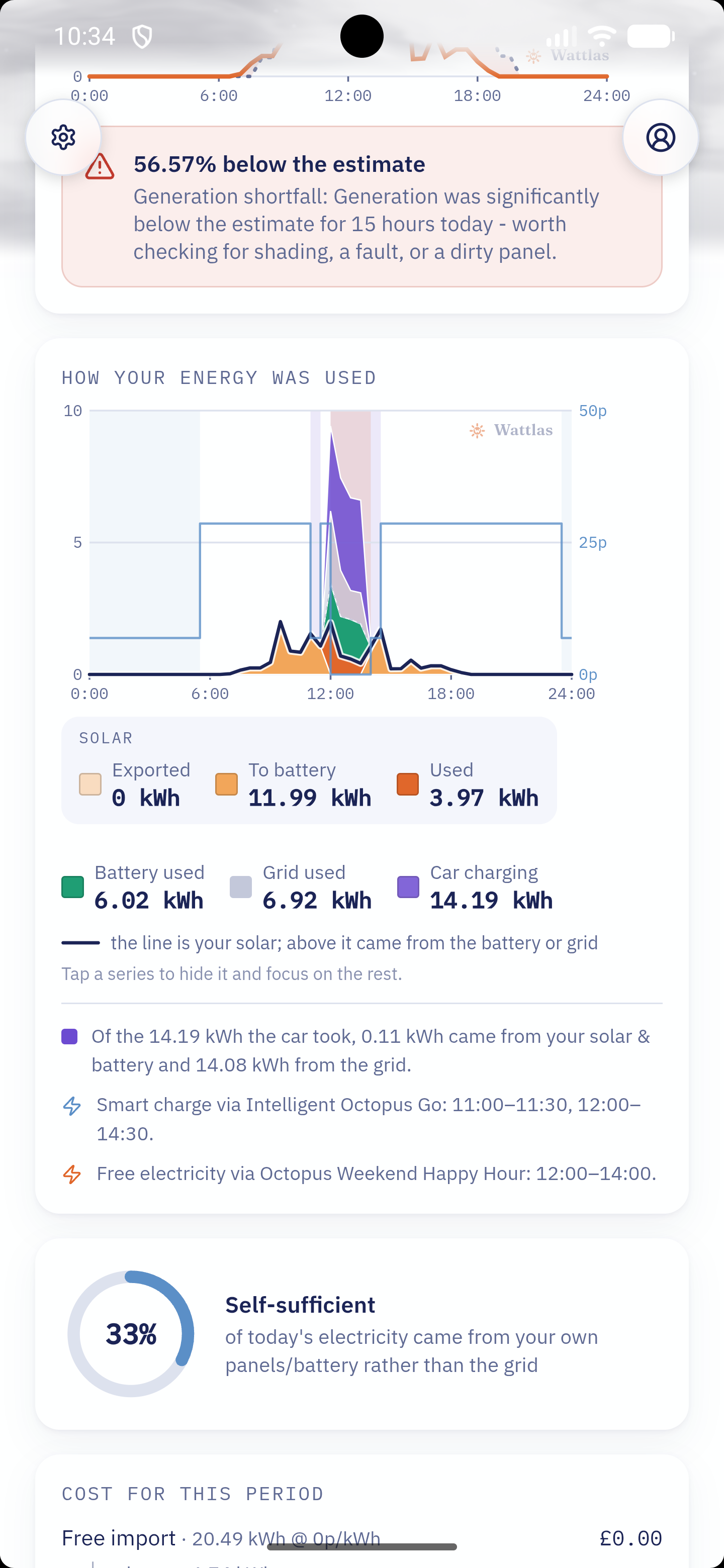
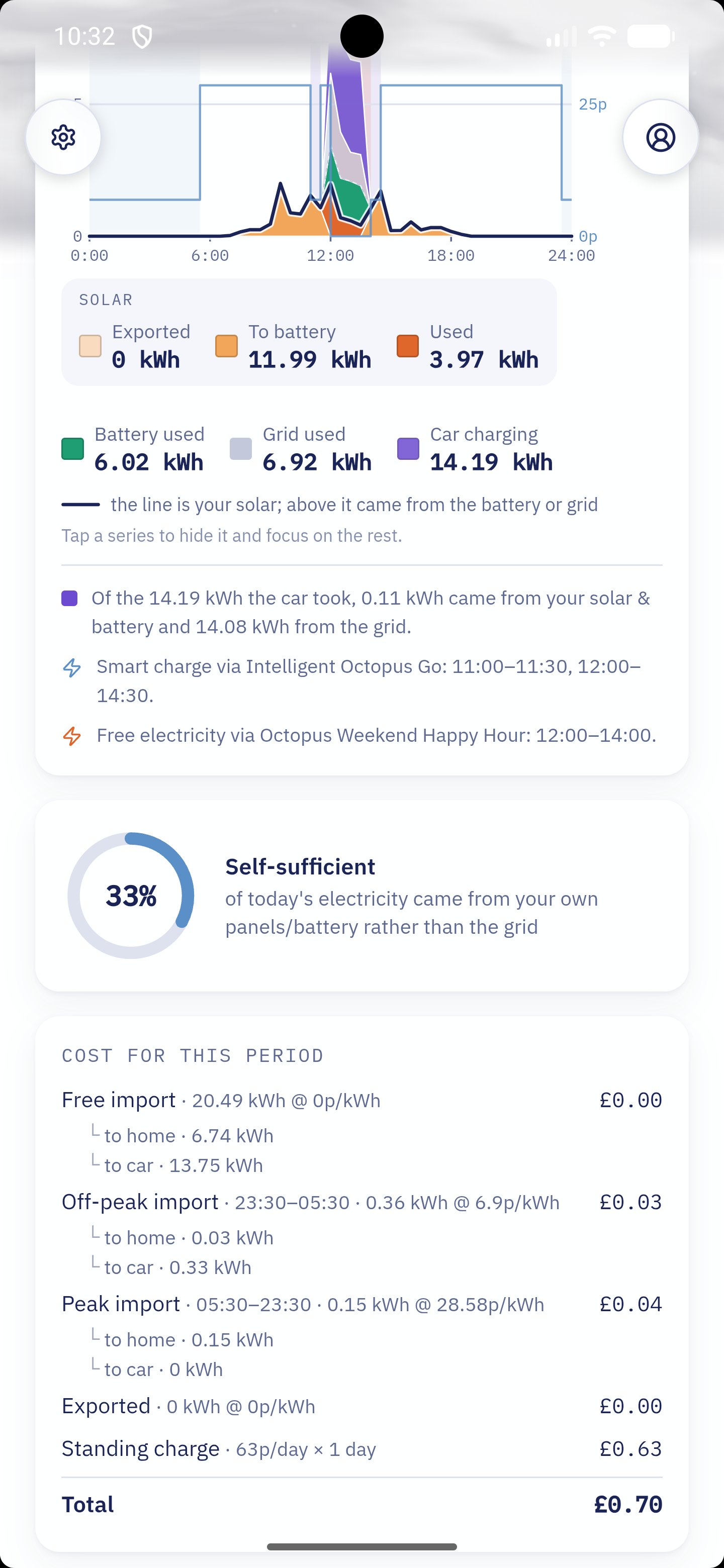
Across the two hours, Wattlas allocated 20.49 kWh to the free window: 13.75 kWh for the car and 6.74 kWh for the home. Each booked hour still has its own 16 kWh cap. The day's displayed total was 70p, including a 63p standing charge—so a free window doesn't mean a free day.
Keeping track between weekends
To build up tokens, you first need to catch the weekday invitations and opt in. In Wattlas, Provider watch shows detected sessions and offers Auto-join for Power Downs and Power Ups. It checks for Octopus's confirmation; you still need to change your usage during the session, and you choose the weekend Happy Hour yourself in Octopus.
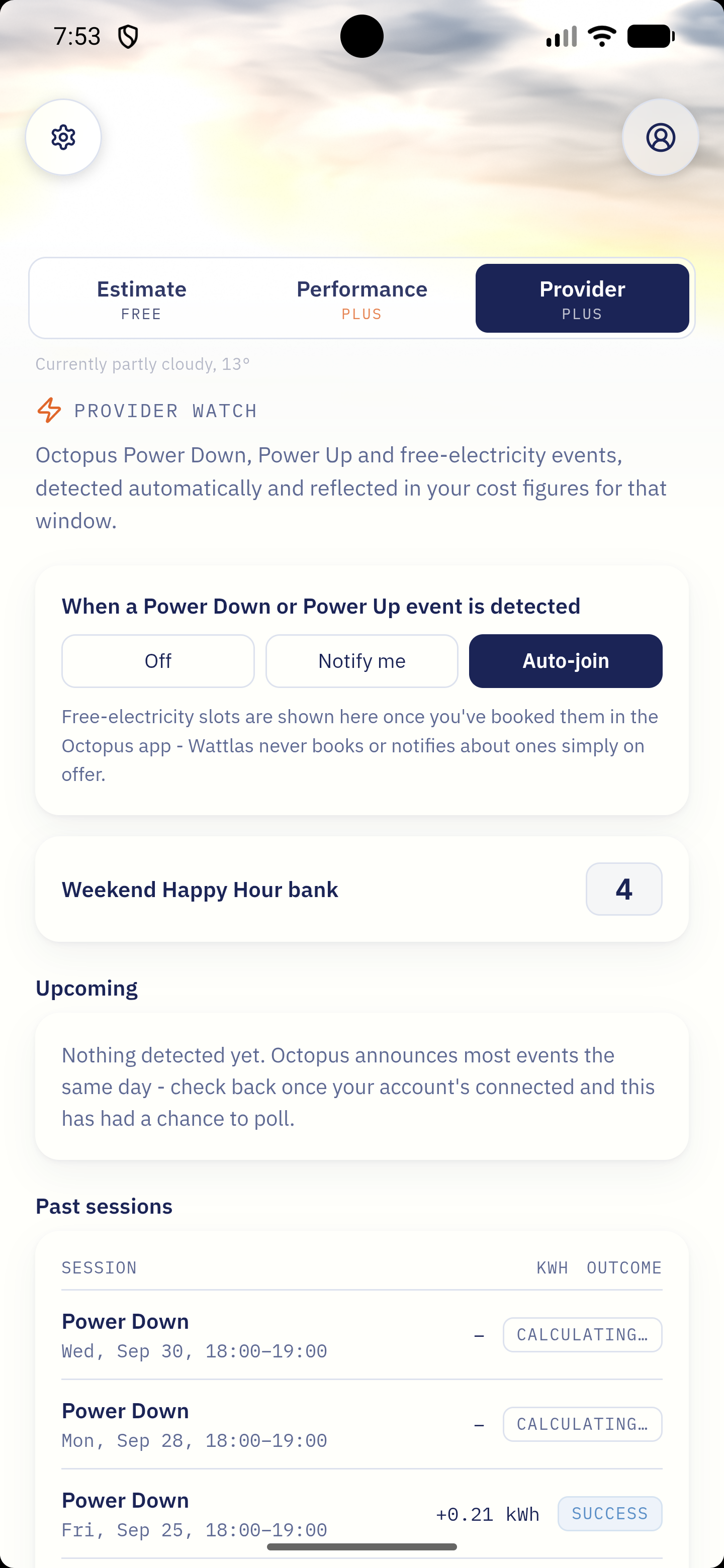
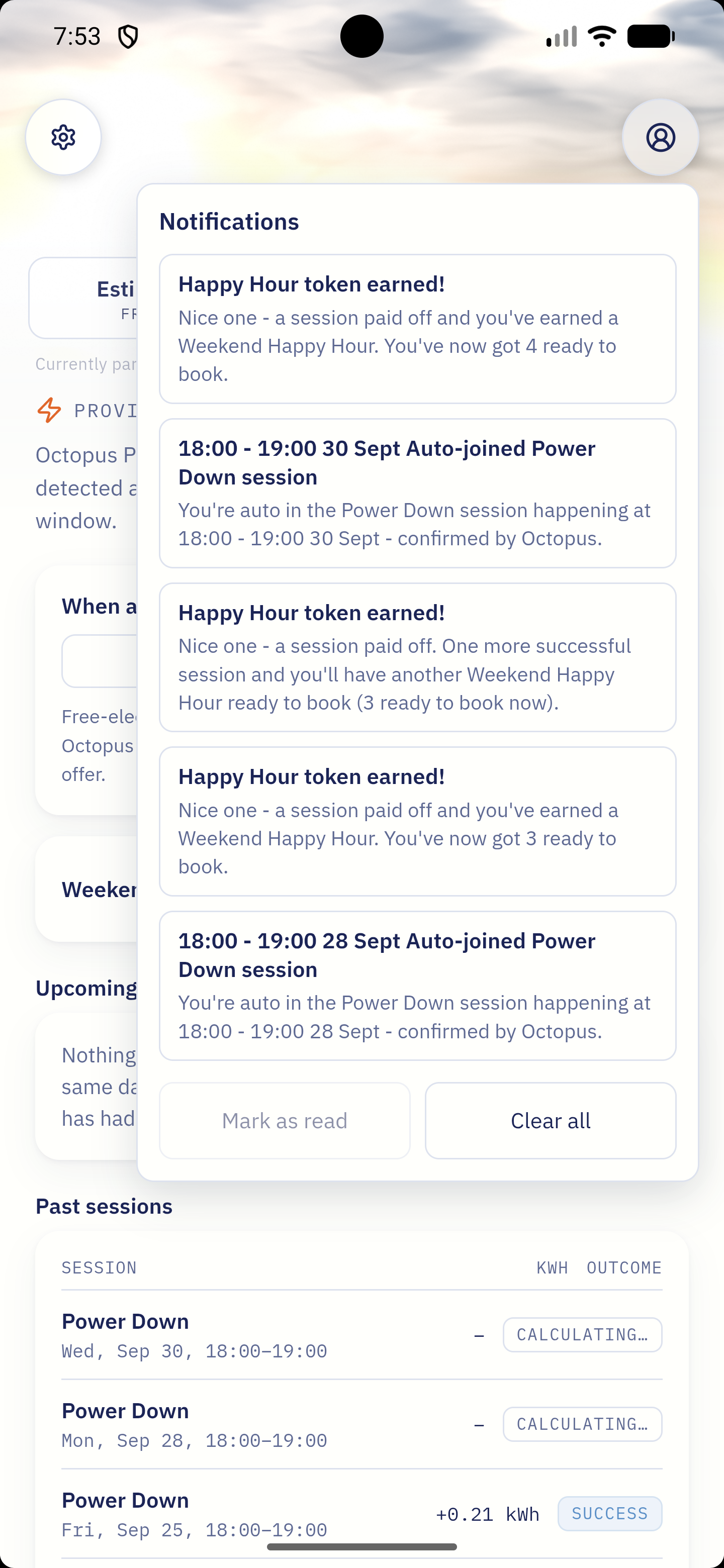
Once a booked window appears in Wattlas, enabled notifications can remind you that morning and five minutes before it starts. Check your Octopus dashboard for the current token balance, available bookings and final bill credits.
A detail Octopus still needs to update
Octopus's new announcement and support page confirm Happy Hours are continuing until February. Its published Happy Hours terms still show the old 1 November deadline and say unused rewards expire then. They haven't yet caught up with the token rules, so check the latest guidance and your account before making a booking.
Sources checked 27 October 2026: Octopus's announcement, its token and rollover guidance, Octopus's Weekend Happy Hours guide and scheme terms. Wattlas is independent of Octopus Energy.
Start monitoring your home energy.
Solar, battery, car charging and energy tariff costs, all in Wattlas.