
Who are they?
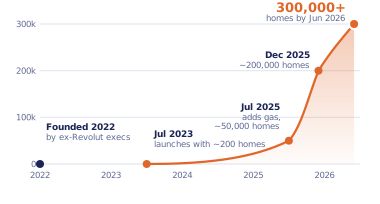
Fuse Energy was started in 2022 by Alan Chang and Charles Orr, who were both early people at Revolut. Rather than apply for a licence from scratch, they bought a small company that already had one. Fuse opened to customers in July 2023 with around 200 homes, got a gas licence at the end of 2024 and started supplying gas in July 2025.
It has grown very quickly since, as the chart above shows. It had about 50,000 homes in the middle of 2025, around 200,000 by December and more than 300,000 by June 2026. A funding round in December 2025 valued it at about £3.7 billion (reported as $5 billion), and in January 2026 it came top of the Sunday Times 100 Tech list with sales of around £130 million. It has also said it wants to expand into Ireland, Spain and the US.
What's different about them?
Price comes first. Fuse says its variable tariff beats the Ofgem price cap and that its fixed deals are among the cheapest in the country. That changes all the time, so check a comparison site with your own usage before you believe anyone's headline figure, theirs included.
It also owns some of its own generation, which is unusual for a supplier this young. It has been buying solar farms, the biggest around 25MW, and has a small wind turbine in Scotland.
Everything runs through the app and website. There's 24-hour chat, answered by a mix of AI and real people, but no phone line. The multi-rate tariff lets you pick your own peak and off-peak hours, which is handy if your usage doesn't fit the usual patterns.
If you have solar panels, the export rate is worth a look. Fuse pays 13p per kWh for exported electricity, and you don't have to buy your electricity from them to get it. The rate is variable and reviewed every quarter, and you'll need an MCS certificate and a meter that records export.
The oddest part is the crypto token. Fuse has launched a token on the Solana blockchain that it pays out for shifting your usage, such as charging off-peak or exporting at the right time, and which can go towards discounts. It's an unusual thing for a household energy supplier to do.
What do customers say?
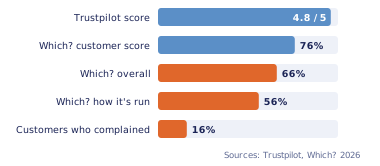
It depends where you look. On Trustpilot, Fuse scores 4.8 out of 5 from more than 12,000 reviews, and 92% of them are five stars. Which?, which rated Fuse for the first time in 2026, is more cautious. It gave Fuse 66% overall, with a customer score of 76% (joint fifth out of 17 suppliers) but only 56% (13th out of 17) for how the company actually runs things. Which? found that 16% of Fuse customers had made a formal complaint, which is high. The most common problems were slow refunds, estimated bills when a meter reading had already been sent, and wrong credit balances. It scored Fuse 3 out of 10 for how it supports vulnerable customers.
What should you watch out for?
Fuse is young and growing very quickly. It hasn't been through anything like the 2021 to 2022 energy crisis, when around 30 suppliers went under, and rapid growth is exactly when billing and customer service tend to struggle. That fits the complaints Which? picked up.
If you like to be able to ring someone, or you look after someone who does, the lack of a phone line matters. Fuse also doesn't take prepayment customers, so you'll need to pay by Direct Debit.
Its terms let it ask for a security deposit before or during supply, and people on forums like MoneySavingExpert say they've been asked for quite large amounts when switching. Find out before you commit.
Treat any crypto rewards as a bonus rather than part of the price, because a token can lose value. And remember that variable tariffs and the 13p export rate can go down as well as up. Leaving a fixed deal early costs £50 per fuel.
None of this means Fuse is about to fail. Since March 2025, Ofgem has required suppliers to build up a cash buffer of £115 per dual-fuel customer so they can cope with price shocks. And if any supplier does go bust, Ofgem moves its customers to a new one. Your energy keeps flowing, you don't have to do anything, and any credit on your account is protected.
Anything else to know?
Fuse was one of the companies allowed to bid into NESO's Demand Flexibility Service in 2025/26, the scheme that pays households to use less at busy times. It isn't listed on any of the 2026/27 requests so far, so if those paid sessions matter to you, ask Fuse what it offers now before you switch.
Should you switch?
If you're happy doing everything through an app, pay by Direct Debit and mainly want a low price, Fuse is well worth considering. Its export rate is worth a look for solar owners even if you stay with your current supplier. If you want a phone line or prepay, or you'd rather go with a supplier that has a longer track record, the complaint numbers and Fuse's short history are good reasons to wait a while.
Whoever you end up with, it's worth checking your bills add up. Wattlas works with any supplier. Pick the manual tariff option in Setup, put in your rates, and it'll price your usage day by day.
Sources
Wikipedia - Fuse Energy (history, customer numbers, funding,
generation)
EU-Startups - Fuse Energy's December 2025 funding round
Fuse Energy - tariffs, app and support
Fuse Energy - export tariff (23 July 2026)
Fuse Energy - supply terms and conditions (security deposits)
Decrypt - Fuse's Solana token (September 2024)
Which? - Fuse Energy review (2026)
Trustpilot - Fuse Energy reviews
MoneySavingExpert Forum - Fuse upfront payment to switch
Switch Pilot - Fuse Energy review 2026 (support, exit fees)
Ofgem - Financial resilience in the energy retail market
Ofgem - What happens if your energy supplier goes bust
NESO Data Portal - Demand Flexibility Service requests and eligible
providers
The Fuse Energy logo is a trademark of its owner and is shown only
to identify the company. Wattlas isn't affiliated with Fuse
Energy.
Start monitoring your home energy.
Solar, battery, car charging and energy tariff costs, all in Wattlas.